
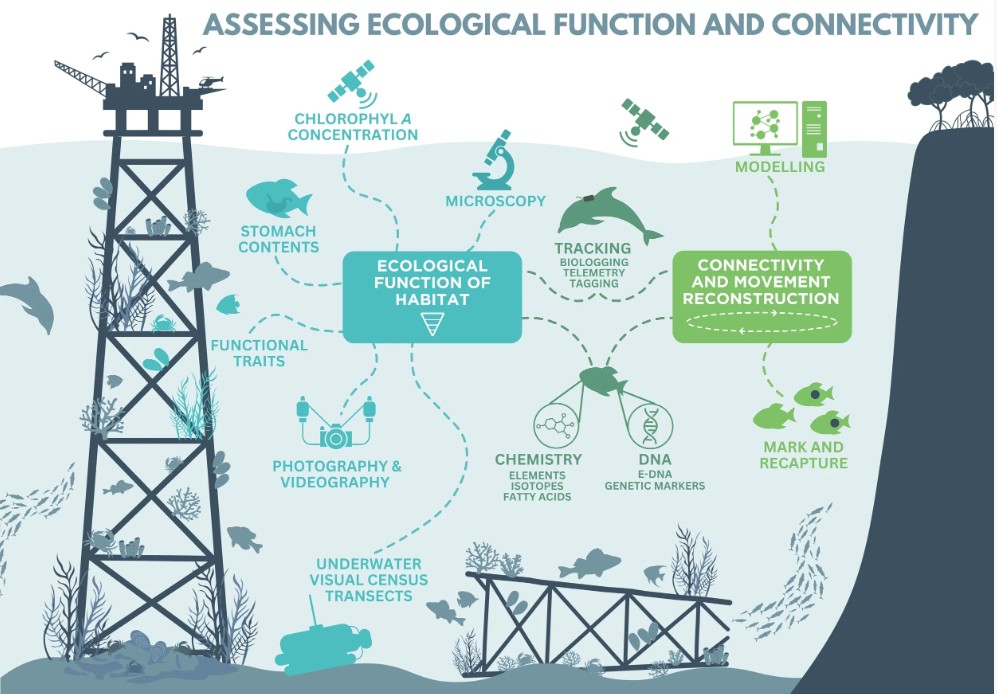
Summary and visual representation of different approaches to assess ecological function and connectivity.
News
A new research paper led by The National Decommissioning Centre Research Fellow Dr Alethea Madgett brings together multiple scientific approaches to improve our understanding of how offshore infrastructure contributes to marine ecosystems.
The paper, ‘Multiple lines of evidence framework for quantifying ecosystem function and connectivity of offshore infrastructure: a rigs-to-reefs perspective’, provides a more robust framework for assessing the ecosystem function across different spatial and temporal scales.
The framework brings together multiple complementary approaches, including video surveys, environmental DNA, trophic analyses, movement tracking, chemical and genetic markers, and biophysical modelling.
By integrating these lines of evidence, the framework provides a harmonised and transparent basis for quantitative, context-specific decision-making around the ecological role and management of offshore infrastructure.
The framework could help inform future decommissioning decisions by providing a more comprehensive understanding of the ecological function and connectivity associated with offshore structures.
Dr Madgett, Research Fellow in Fish Ecology and Artificial Reefs, said: “This work is especially timely as thousands of offshore oil and gas structures approach the end of their operational lives. We hope that this offers a valuable tool for informing the future management of these structures.
“While developed with oil and gas infrastructure in mind, the framework is broadly applicable to offshore infrastructure and habitat enhancement initiatives, helping to maximise ecological function, fisheries productivity and biodiversity restoration.”
Read the full paper in – Frontiers in Marine Science.
Notes for Editors
| Published | Wednesday September 9th, 2026 |