
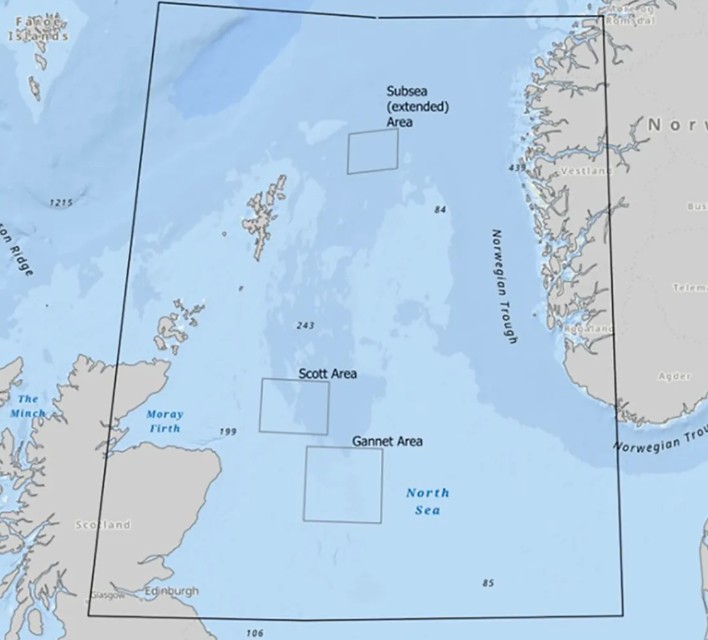
Case study areas and extent of the North Sea AIS dataset.
News
New research from the NDC explores how vessel emissions associated with offshore decommissioning activities can be quantified at unprecedented spatial resolution.
The interdisciplinary study, AIS-driven vessel activity and emissions modelling for offshore decommissioning activities in the North Sea, uses Automated Identification System (AIS) data to reconstruct vessel movements and develop a high-resolution emissions modelling framework for offshore operations in the North Sea.
As offshore decommissioning activity continues to grow across the North Sea, understanding its environmental footprint is becoming increasingly important. However, vessel-related emissions have historically been difficult to quantify at fine spatial scales.
Key findings include:
• AIS-based reconstruction of vessel activity patterns
• Spatially resolved emissions mapping (CO₂, NOₓ, SO₂) at 1 km resolution
• Identification of strong clustering of emissions around offshore infrastructure
• Clear influence of operational modes (transit, idling, dynamic positioning) on emissions intensity
The results show that decommissioning emissions are highly spatially structured and activity-dependent, highlighting the value of AIS-based approaches for improving offshore emissions accounting and supporting regulatory reporting and informing energy transition planning.
The paper was co-authored by Kate Gormley, Sam Cauvin, Shahin Jalili, Malcolm Stone and Richard Neilson.
The work was funded through the The National Decommissioning Centre’s Data 4 Net Zero project.
Read the full paper in Frontiers in Marine Science here – Frontiers | AIS-driven vessel activity and emissions modelling for offshore decommissioning activities in the North Sea
Notes for Editors
| Published | Wednesday June 10th, 2026 |